
Lewis White, Research Officer, Money and Mental Health; Chris Lees, Senior Research Officer, Money and Mental Health
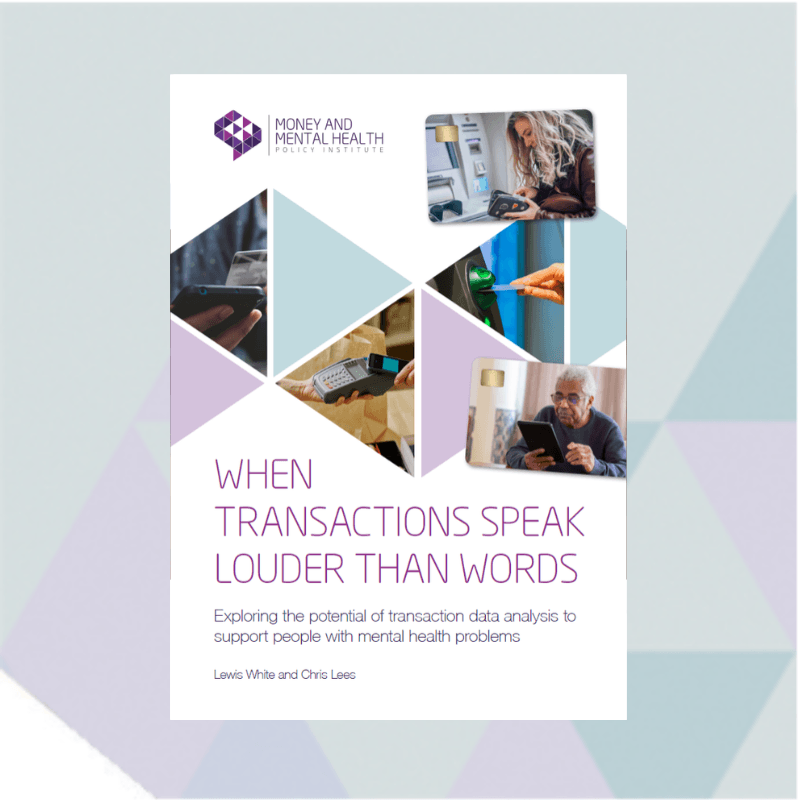
When transactions speak louder than words
Exploring the potential of transaction data analysis to support people with mental health problems
4 November 2026
This report explores the opportunity for banks to play an important role in helping customers get support with their finances and mental health, by using financial data to spot signs people may be struggling and reaching out with support or signposting.
People with mental health problems are significantly more likely to experience financial difficulty, but many struggle to reach out for help.
Transaction data analysis could help banks bridge this gap. Through recognising signs of financial difficulties, banks could proactively contact customers with information of support available or signpost them to organisations that can help.
The research also shows that many people with mental health struggles would welcome their bank using financial data this way, provided there are appropriate safeguards in place to protect their privacy and ensure they are in control of their data.
Our key recommendations:
To help move from transaction data analysis as a concept to a tool that can spot and support people struggling with their finances as a result of a mental health problem, banks should:
- Give customers the option to choose whether their data is analysed in a way that goes beyond existing preventions of harm, such as opting in or opting out depending on the level of analysis or the type of support offered. This choice should be clearly communicated to customers.
- Ensure that there is transparency about how data is used and develop clear complaint procedures.
- Develop a suite of meaningful, targeted interventions that are supported by people with mental health problems before they are put into action at scale.
- Directly involve customers with lived experience of financial difficulty and mental health problems in the design and evaluation of interventions.
To strengthen regulatory and sector support to help banks feel confident implementing this kind of analysis, the Financial Conduct Authority should:
- Clarify how the Consumer Duty applies when it comes to banks using transaction data analysis to support customers with money and mental health problems.
- Identify and encourage best practice for how banks can use transaction data to prevent foreseeable harm and deliver good outcomes for customers.
- Support innovation by encouraging banks to make use of their Regulatory Sandbox to test transaction data analysis.

This report was funded by Lloyds Banking Group. It represents the research and views solely of the authors and of the Money and Mental Health Policy Institute and does not represent the views or experiences of Lloyds Banking Group.