

How banks can help with suicide prevention
Over 420,000 people in problem debt consider taking their own life in England each year, and more than 100,000 people in debt actually attempt suicide.
Money problems are a key contributing factor to suicidal thoughts and feelings, and when people are really struggling it can be hard to tell anyone or ask for help – making it all the more important that those who can spot the warning signs step in to offer support.
“I started borrowing on credit cards and paying it into my account and carrying on with the online gambling. Eventually, you run out of money and sources of credit… The pattern would have been quite discernible because the money was going into various well-known online gambling sites, and my bills weren’t getting paid towards the end. I was going overdrawn and having to get money from somewhere else to sort that out. It wouldn’t have been rocket science to look at the signs.” Expert by experience
Banks have a critical opportunity because of the unique insight they have into people’s finances. For example, banks can spot and intervene when customers may be experiencing debt problems or income drops which can contribute to suicidal thoughts and feelings.
We are delighted that so many major banks have committed to working with us on this vital issue. Our hope is that together we can lead a step-change in support for people at risk of suicide, and ultimately help to save lives.
The Suicide Prevention Action Lab
The Suicide Prevention Action Lab is working directly with financial service providers to explore how firms can best support customers at risk of or experiencing suicidal thoughts or feelings.
It brings together five major banks to explore new approaches to helping customers at risk of suicide. We’ll be developing and testing new ways to support people, drawing on insights from people with lived experience of suicidal thoughts or actions and from our research. Together, we’ll develop new and improved ways to identify and support customers at risk of or experiencing suicidal thoughts or feelings.
At the end of the programme in Summer 2028, we’ll share our impact and findings with the industry, so that all banks can learn from the programme – with the aim of leading a step-change in support for people at risk of suicide, and ultimately saving lives.
How experts by experience support the Suicide Prevention Action Lab
Lee is a member of Money and Mental Health’s Research Community of experts by experience. Back in 2014, he experienced suicidal thoughts and feelings after building up significant debt during a period of poor mental health.
Who we’re working with
Five major firms come together to develop and test new ideas, drawing on insights from people with lived experience of suicidal thoughts or actions and from Money and Mental Health’s research, as well as from a steering group including the Financial Conduct Authority. Those five firms are Barclays, HSBC UK, Lloyds, Monzo and Nationwide.





About the Suicide Prevention Action Lab
The Action Lab is funded by the five participating firms.
The Suicide Prevention Action Lab is a 26-month programme, set to run until the summer of 2028. At that stage, we’ll share our impact and findings with the industry, so that all banks can learn from the programme – with the aim of leading a step-change in support for people at risk of suicide, and ultimately saving lives.
An Action Learning Set (ALS) is a group of individuals who meet regularly to work on and solve common challenges. Suicide Prevention Action Lab members will share with the group the challenges they’re facing in developing and progressing supportive tools for customers at risk of or experiencing suicidal thoughts and feelings. The group of engaged peers supports one another by asking questions to help unlock ways forward and innovative solutions.
The Suicide Prevention Action Lab team will facilitate ALS meetings, guiding the group through the classic structure for Action Learning sessions and helping members work together to overcome barriers to tackling gambling harm within their organisation.
Like all of our work of Money and Mental Health, the Suicide Prevention Action Lab will be grounded in lived experience through insights we gather from our Research Community. The Research Community is a group of around 5,000 people with lived experience of mental health problems, who volunteer their time to participate in regular surveys and focus groups.
Given the potentially distressing nature of this topic, we will be particularly mindful about going to the Research Community with surveys relating to the Suicide Prevention Action Lab, and only do so where there is a gap in the existing body of research.
As well as participation in surveys and focus groups, three individuals with lived experience will sit on the Steering Group for the Suicide Prevention Action Lab, to provide us with strategic direction and challenge. This ensures that the Action Lab remains focused on the real experiences of people we are trying to help.
Banks have a unique insight they have into people’s finances. For example, banks can spot and intervene when customers may be experiencing debt problems or income drops which can contribute to suicidal thoughts and feelings.
Here at Money and Mental Health, we have vast experience and expertise in working with financial services providers. We believe we can help to make a difference by building on our existing network, knowledge and expertise.
The Financial Conduct Authority, the financial services regulator, requires firms to take reasonable steps to prevent foreseeable harm through its Consumer Duty. We are working directly with a group of firms to deliver on this principle as it applies to suicide prevention.
The Suicide Prevention Action Lab steering group contains three members of our Research Community, in addition to representatives of the Financial Conduct Authority and Samaritans – further names and organisations will be added to this list once they have been confirmed.
 Suicide prevention
Launching our new Suicide Prevention Action Lab for financial services
Nikki Bond, Head of Innovation, Money and Mental Health
September 10, 2026Martin Lewis charity brings together five major banks to help tackle suicide
September 10, 2026
Banks’ role in suicide prevention
How financial services should support customers who may be at risk of suicidality.
February 05, 2026Big Issue
An interview in the Big Issue with our Research Community member, Rob, speaking about the mental health impact of feeling bombarded by contact from creditors.
December 22, 2023Health select committee
Polly Mackenzie, Author Health select committee 8 September 2016 We submitted a consulation response
November 09, 2016

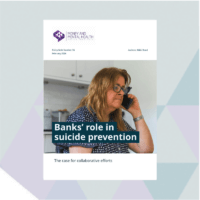

This policy paper looks at the important opportunity financial services have to support customers who may be at risk of experiencing suicidal thoughts and feelings. The role of financial difficulty in this is distinct and measurable: individuals in problem debt are three times more likely to attempt suicide than those without.
Banks often have a unique insight into when people may be struggling with these issues through being able to see their financial data, and through the contacts they have with customers through frontline staff.