
John Lee, Senior Research Officer, Money and Mental Health; Elle Crossley, Senior Research Officer, Money and Mental Health
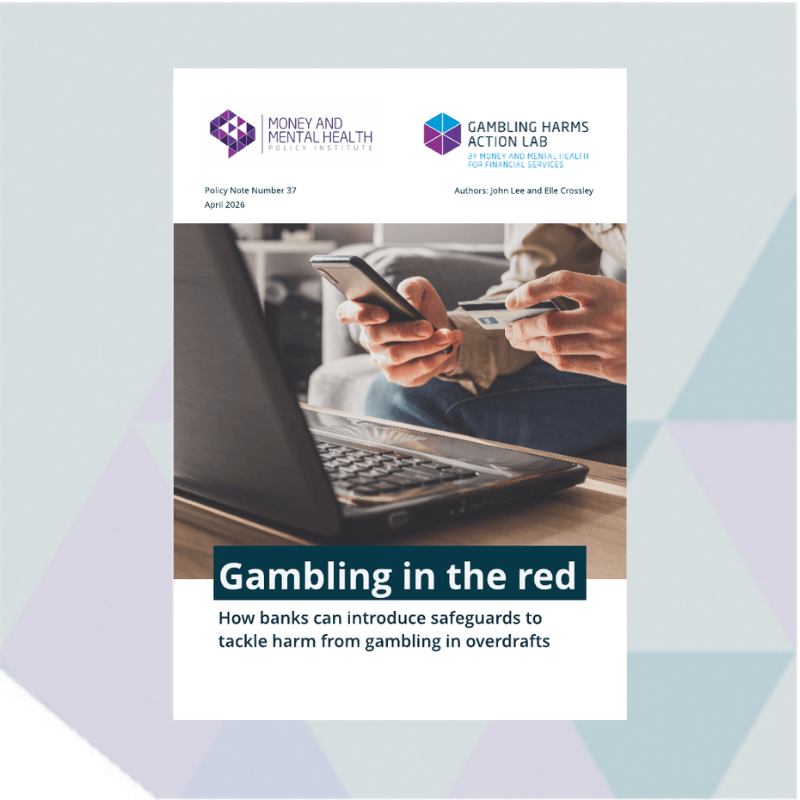
Gambling in the red
How banks can introduce safeguards to tackle harm from gambling in overdrafts
This policy note explores the harm that can result from gambling with borrowed funds, and makes the case for current account providers to consider blocking gambling in overdrafts – while also providing a series of recommendations short of an outright ban that would see stronger customer safeguards around gambling in overdrafts.
Drawing on survey responses and in-depth interviews with members of our Research Community, as well as analysis of Financial Ombudsman Service (FOS) complaints, the paper sets out the mental health, financial and relationship harms caused by overdraft-funded gambling. It argues that the existing regulatory framework already requires banks to act and that practical, proportionate solutions are within reach.
Key findings include:
- Nine in ten survey respondents from Money and Mental Health’s Research Community agreed that overdrafts are a form of debt similar to credit cards or unsecured loans, while 76% agreed that overdrafts should be for emergencies and unexpected bills and purchases.
- The addictive nature of gambling often interacted with respondents’ existing mental health conditions, making it challenging to manage gambling. Respondents often turned to gambling as it offered the possibility of escaping their situation, but instead gambling in overdrafts led to further financial difficulty and many spoke of the stress, anxiety and depression that resulted from this cycle.
- Respondents found that repeated small-stakes gambling while in an overdraft led to reinforcing harmful behavioural patterns, including chasing losses and habitual play.
- For those living constantly in an overdraft, use of overdrafts for gambling can make gambling seem artificially affordable. Respondents used their overdraft to fund all living expenses, both essential and non-essential, including gambling.
- The experiences of those gambling in an overdraft shares a lot in common with debt-funded gambling more broadly; respondents described going further into debt in the hopes of winning big. This behaviour often made respondents’ financial circumstances worse and could escalate rapidly.
Our key recommendations:
We’re calling on financial services firms to tackle harm from gambling in overdrafts by adopting one or more of the following recommendations:
- Automatically blocking gambling payments in authorised and unauthorised overdrafts
- Automatically blocking gambling payments in unauthorised overdrafts only.
- Offering customers the option to block gambling in authorised and/or unauthorised overdrafts
- Identifying and proactively communicating with all customers who are identified as gambling within an overdraft.
- Reviewing internal policies about what triggers an overdraft review.
The FCA should also take action by highlighting best practice – proactively sharing examples of good meaningful action on gambling in overdrafts so other firms can emulate and understand how they too can prevent foreseeable harm for customers.
This work is funded through a regulatory settlement by the UK Gambling Commission. When the Gambling Commission takes regulatory action against a gambling operator, one of the outcomes of that action can be a payment in lieu of the financial penalty the Commission might otherwise impose for breach of a licence condition. The Gambling Commission regularly reviews proposals for destinations of regulatory settlements and awarded funding for the Gambling Harms Action Lab project in July 2023.