


Francesca Smith, Senior Research Officer, Money and Mental Health
Solving problems where they start: Our new evidence on the need for integrated money and mental health support
13 May 2026
- Our new report highlights the scale of harm that money worries like affording food and paying debts are having on people’s mental health – 3.6 million people with mental health problems have worried about affording enough food in the last year.
- Free advice services offer help on issues like debt, benefits, housing, and energy costs, and can greatly improve people’s financial and mental wellbeing.
- Despite this, most mental health services do not routinely help people access this financial support. Only around 1 in 7 people using NHS talking therapies are offered money advice.
- The government’s planned “Neighbourhood Health Service” aims to combine healthcare with practical support like debt and employment advice in local communities, which is extremely welcome.
- However, as implementation gets underway, we have seen a lack of clear guidance for local leaders on the importance of integrating advice into health settings, and how to do it well.
- The report outlines 10 principles for best practice in designing and delivering these interventions, and highlights successful examples, such as Liverpool’s Citizens Advice on Prescription service, where providing financial advice through GP and mental health services improved wellbeing and reduced pressure on the NHS.
If you’re worrying about how you’re going to afford to feed your family, anticipating letters about unpaid debts dropping through the letterbox, or living in fear of an unexpected expense like your car breaking down – it’s no wonder that this might be having a huge impact on your mental health.
And you wouldn’t be alone. Our new report finds that 3.6 million people with mental health problems have worried about being able to afford enough food to eat in the last 12 months, and are three times more likely to have done so than someone without a mental health problem (26% vs 9%).
Ignoring financial hardship in mental healthcare undermines recovery
Fortunately, free and independent advice services can help many in this situation. These services support people with issues including housing, benefits, problem debt, energy poverty and more, and there is a growing evidence base that shows improving access to them is one of the most impactful preventative ‘health’ interventions available.
Integrated money and mental health interventions that help people with mental health problems to get support with their finances have a significant positive impact across a range of indicators, including service capacity, staff wellbeing, cost effectiveness, and health outcomes.
Yet, most people seeking mental health support will find that their local health service isn’t set up to routinely identify this huge underlying driver of poor mental health, and help people to access this advice where they need it. In fact, only an estimated one in seven (14%) people who are accessing NHS talking therapies are offered access to help with their finances.
While for some people struggling with both their money and mental health, clinical treatment, like medication or psychotherapy, can help or lead to recovery. For many, this alone won’t resolve the financial pressures at the root of their daily stress and strain.
The government’s shift to a ‘neighbourhood’ health service is an unmissable opportunity to join up money and mental health support
That’s why we were delighted to see the government put a new ‘Neighbourhood Health Service’ at the centre of its 10 Year Plan to reform the NHS, announced last year. This would see community-based health services providing access to clinical healthcare and support for socio-economic issues such as debt and employment advice all under one roof.
However, implementation is underway, and initial guidance has been published. Yet, there’s been next-to-no detail on how exactly local health leaders could make this happen, or what best practice would look like.
A key aspect of this ‘neighbourhood health’ approach is to shift decision-making and resources away from Westminster and into the hands of local health leaders. It’s vital, then, that they are given the guidance and support they need to understand the importance of integrated money and mental health care – and ways to do it that will work.
The government should therefore ensure that upcoming iterations of neighbourhood health guidance offer local leaders this detail, and draw on pockets of excellent practice where this is already happening around the country.
We’re offering a blueprint for action
And should the government need any help with that, luckily for them they can simply turn to our new report for inspiration!
Following a review of a range of existing examples of integrated money and mental health interventions across the country, we have identified a set of 10 principles that are key to successful delivery and spotlight a range of case studies that illustrate these principles, and demonstrate the diverse routes to impactful outcomes in different local contexts.
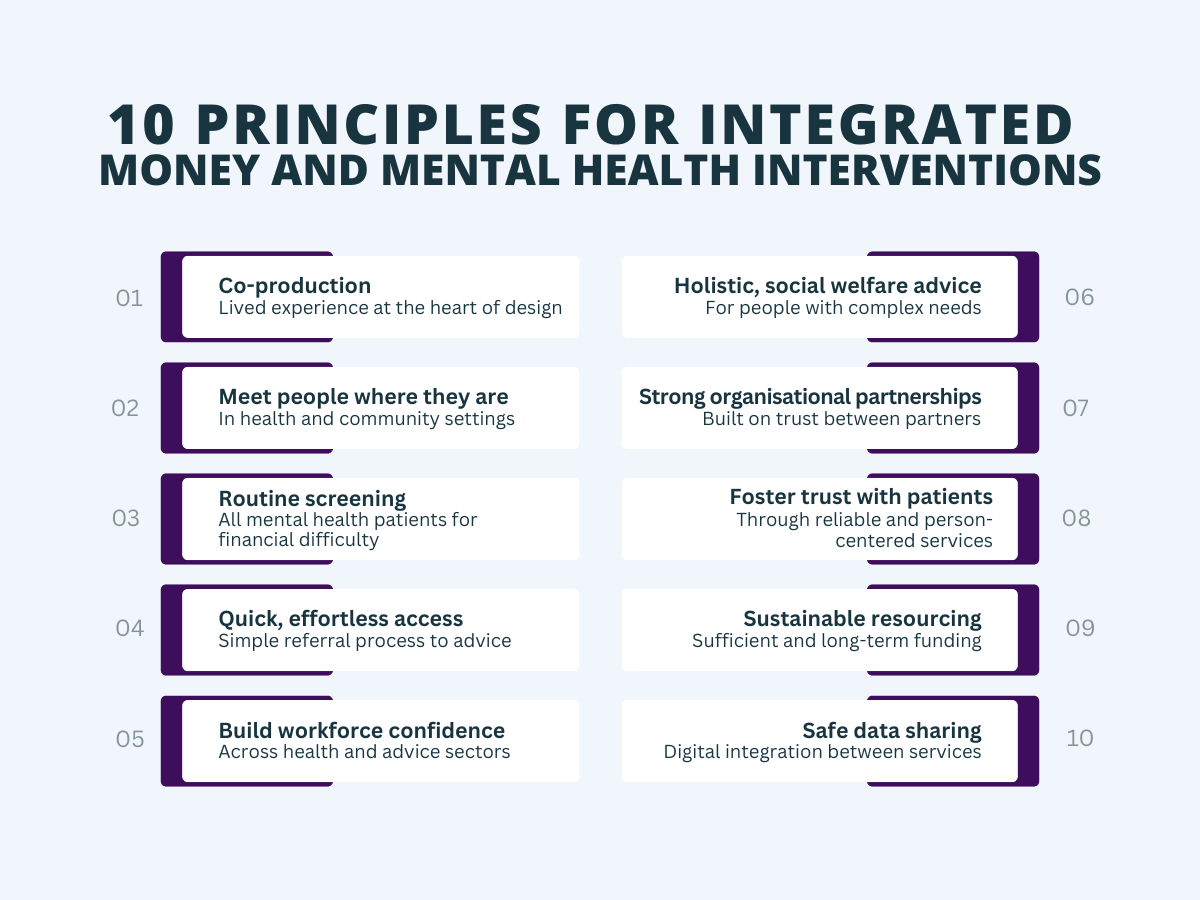
For example, the Liverpool Citizens Advice on Prescription service, which provides free expert social welfare advice at all GP practices and mental health settings around the city. It is ensuring that people who present to their GP with non-medical issues can get quick access to free expert advice. Almost all clients reported that their mental health improved, and the intervention generated significant savings for the NHS by reducing prescription requirements, GP appointments and A&E attendance among clients.
You can find out more about these principles and other case study examples that bring them to life in our new report.
If you’re in need of support with your money and/or mental health, it’s important to know that you’re not alone and help is out there. You can find information about organisations that can help here.